
Brisbane has undergone a significant transformation over the past decade, shifting from what was once considered a quieter, secondary market into a genuine major Australian city with strong economic fundamentals, sustained infrastructure investment, and growing national attention.
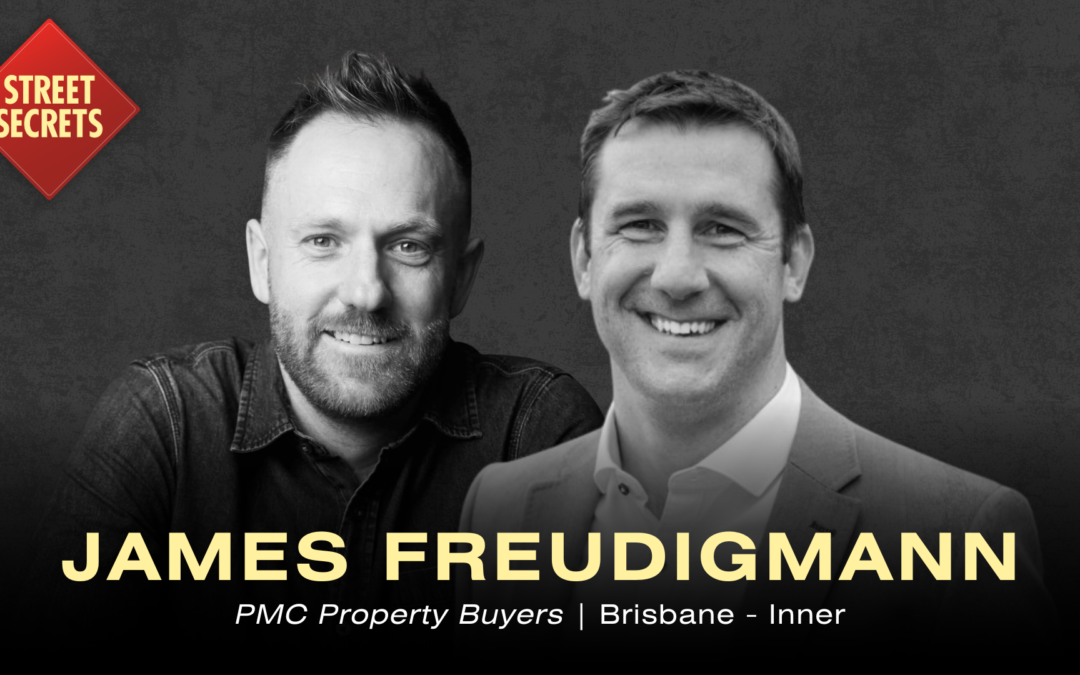
James Freudigmann recently joined Chris Bates on the Street Secrets podcast. In this episode, we unpack how Brisbane has evolved, what is driving its growth, and how buyers should be thinking about the market today.
At PMC Property Buyers, we are seeing first-hand how quickly conditions are changing. Success in Brisbane is now less about timing the market and more about understanding its structure, its pockets and the forces shaping long-term demand.
Brisbane’s transformation into a major city
One of the most defining changes in Brisbane over the past 7 to 10 years has been the scale of infrastructure investment.
Projects such as Brisbane Metro, Cross River Rail, and major road and transport upgrades have fundamentally reshaped how the city functions and how people move through it.
This level of investment has helped reposition Brisbane from a smaller capital city into a properly connected metropolitan hub, with improved accessibility, stronger employment nodes and enhanced liveability.
James notes that this shift has materially changed confidence in the market. Brisbane is no longer viewed as a stepping stone city, but as a long-term destination.
The evolution of the Brisbane property cycle
Having worked across valuation and buyers agency since the late 1990s, James Freudigmann has seen Brisbane move through multiple cycles, including:
- Strong growth phases in the early 2000s
- A cooling period following the Global Financial Crisis
- A prolonged quieter period through the 2010s
- A significant re-acceleration post-COVID
One of the key lessons from this history is that Brisbane does not move in a straight line. It cycles through periods of strong growth, oversupply in certain segments such as apartments, and then renewed demand as fundamentals tighten again.
Understanding where the market sits within that cycle is critical for buyers making long-term decisions.
Why Brisbane is attracting people now
The recent strength in Brisbane is not being driven by a single factor, but a combination of structural changes.
Population migration
Post-COVID, there has been a clear shift of people moving from Sydney and Melbourne into Southeast Queensland, driven by affordability, lifestyle and flexibility.
This is not limited to older downsizers. A significant portion is younger buyers who feel locked out of southern capital cities, with parents often following later to be closer to family.
Employment and business relocation
More companies are relocating or expanding their presence in Brisbane, bringing higher-paying roles and strengthening the local economy.
This shift has helped change perception from a regional capital to a city with genuine career depth.
Infrastructure confidence
Large-scale infrastructure investment has reinforced long-term confidence in the city’s trajectory and improved its functionality as a major urban centre.
The rise of lifestyle-driven decision making
A major behavioural shift in the Brisbane market is the increasing importance of lifestyle.
Buyers are no longer focused solely on affordability or yield. Instead, they are asking:
- How do I live day to day
- What does my commute look like
- What amenities are nearby
- How does this support my family long term
This has created a stronger preference for established suburbs with access to parks, schools, cafes, transport and employment hubs.
The result is a market where quality and liveability are increasingly priced in.
Why “buy without regrets” matters more than ever
A core principle discussed in this episode is the idea of buying without regrets.
In practice, this means focusing on properties that:
- Will suit your lifestyle for 10 years, not just 3
- Have long-term adaptability and improvement potential
- Are aligned to both current needs and future flexibility
This approach shifts the decision away from short-term thinking and toward long-term suitability.
It also reinforces an important point. A good purchase is not just about today’s price, but about how the property performs over time.
The growing importance of quality assets
One of the most notable shifts in Brisbane has been the widening gap between average and premium stock within the same suburb.
Buyers are increasingly willing to pay for:
- Better streets
- Stronger aspects incorporating breezes and natural light
- Larger or more functional land sizes
- Renovated or well-designed homes
- Proximity to amenity and transport
- Quality public school catchment zones
In many cases, the difference between properties in the same suburb can now be substantial depending on street, zoning or catchment.
Quality is being pursued more aggressively than ever before.
Where investors often go wrong
A recurring theme in the episode is the risk associated with off-the-plan, high-density or large-scale greenfield developments.
While these assets may look attractive on paper due to depreciation benefits or initial affordability, they often come with risks such as:
- Oversupply in certain areas
- Lack of owner-occupier demand
- Homogeneous housing stock
- Reduced long-term scarcity
- Weak maintenance and neighbourhood quality over time
Markets with too high a proportion of investors can also lack the stability and pride of ownership that supports long-term capital growth.
Not all growth is equal growth.
Why area expertise matters more in Brisbane than ever
As Brisbane has expanded, it has become increasingly important to understand micro-markets at a suburb and even street level.
Within the same suburb, values can shift significantly based on:
- School catchments
- Zoning restrictions
- Street position / aspect from the rear
- Flood risk and overland flow
- Density allowances
- Renovation versus knockdown potential
Because of this, PMC operates on a highly specialised model, with buyers agents focused on specific geographic pockets.
This allows for deeper market coverage, stronger agent relationships and more accurate pricing insights.
The role of agent relationships
Another key advantage in competitive markets is access to information before it becomes public.
Strong relationships with selling agents allow buyers agents to:
- Identify off-market and pre-market opportunities
- Understand true buyer competition levels
- Negotiate with better context
- Stay ahead of new listings
These relationships are built over time through consistent presence, communication and trust within specific suburbs.
In a market like Brisbane, this localised network effect plays a significant role in securing better outcomes for clients.
Final thoughts
Brisbane is no longer the “easy alternative” market it may once have been perceived to be.
It is a growing, evolving and increasingly sophisticated property market shaped by infrastructure, migration, lifestyle demand and structural economic change.
For buyers, success now comes down to understanding the nuances of location, quality and timing, rather than relying on broad assumptions about affordability or taking the sales agents word for it.
As this episode highlights, the buyers who perform best in Brisbane are those who approach it with clarity, strategy and a long-term mindset.
Looking to buy property in South East Queensland?
Our team of buyers agents are based in Brisbane, Moreton Bay, the Sunshine Coast and Gold Coast, carry out thorough due diligence, helping you navigate the market and secure the right place.