
2026 Spring Market Update
2026 Spring
Market Update
17 September 2026
Cotality suggests the national market is down 3.6% since its peak in March. Digging deeper, the Sydney market is down 7.1% since its peak. This highlights the classic lag in data between what we are seeing “live” on the ground in the markets we specialise in compared to what the major data houses are reporting. When we released our last quarterly market update in Winter, nearly three months ago, our Sydney team were suggesting the market was already off between 10–12%.
This gap between what is happening live on the ground and what is subsequently reported by the key property data sources will continue to play out. The data provides an important historical reference point, but it can take time for changes in buyer behaviour, vendor expectations and transaction volumes to flow through into the headline numbers.
Below, we have summarised what we are seeing “live” on the ground across our six offices, including where buyer demand is changing, how vendors are responding and what we expect to see over the coming months.
National
The national market is down 3.6%, below its peak recorded in March this year. You would be led to believe that it’s already been a 20% + correction based on the media hype and attention the market is currently receiving. While conditions have softened, the data suggests the national market has not experienced a correction of that scale.
With all four of the big banks now predicting another interest rate rise towards the end of this year, we expect these softer market conditions to continue through to the end of the year. All eyes will be on inflation data and the RBA’s commentary as the year draws to a close, particularly for any indication of where interest rates may settle.
We expect the market to firm up and find its floor once it becomes evident that we are at the peak of the interest rate cycle and murmurs start to appear, with economists beginning to predict interest rate cuts. In the meantime, buyers will continue to build up on the sidelines while vendors will generally resist selling if they aren’t forced to. This could create a build-up in buyer demand and market activity once sentiment begins to turn.
SYDNEY
Note; our commentary is specifically focused on the Northern Beaches and North Shore marketplaces that we specialise in.
Looking Back on the Sydney’s Northern Beaches and Lower North Shore Markets in the Past Quarter
There is no doubt that the more expensive, prestige end of the market has witnessed the largest declines in value over the past quarter. In certain pockets of the Lower North Shore, particularly Mosman houses, we have witnessed values fall by between 15–20% for prestige homes. These higher-value properties have been more exposed to changing buyer sentiment, particularly as borrowing capacity and affordability come under greater pressure.
Whilst the lower quartile of the market has been more resilient, it has also started to experience some softening, albeit not at the same level as the upper end of the market. Buyers remain active where properties are well located and appropriately priced, but there is less urgency in the market and greater scrutiny around value. Across the Northern Beaches and Lower North Shore, units have generally proven more resilient throughout the current downturn, supported by their relative affordability compared to detached housing and the broader affordability constraints facing buyers.
Predicting the Sydney Market Moving Forward
Looking ahead, we expect the Spring selling season to be subdued, with vendors generally choosing not to list their properties unless there is a strong motivation to sell. Higher interest rates and softer market conditions are likely to continue weighing on vendor confidence, meaning we may see fewer properties brought to market than would typically be expected during Spring.
For buyers, this is likely to create an interesting dynamic. While there may be less competition overall, the limited supply of quality properties means well-priced and well-located homes can still attract strong interest when they do come to market. We expect the market to remain selective in the short term, with a clear gap between properties that are priced in line with current market conditions and those where vendors are holding onto expectations from the previous cycle.
As conditions continue to evolve, accurate valuation, thorough due diligence and strong negotiation will remain particularly important. Rather than assuming that every property has fallen by the same amount, buyers will need to assess each opportunity on its individual merits and understand where current market value actually sits.
Looking to buy on Sydney’s Northern Beaches or Lower North Shore?
Our local team has extensive experience across these areas and the wider Sydney property market. To learn more about the surrounding suburbs and how we can help, visit our Sydney buyers agent page.
BRISBANE
Note; the comments below are for the inner-city suburbs of Brisbane and the Redcliffe peninsular
Our Co-Founder James Freudigmann has a career spanning nearly twenty years as a buyers agent, including navigating the GFC, He has observed with some confidence a correction like this has never hit Brisbane this fast, or this hard. Investors evaporated. First home buyers retreated to the family home, suddenly rediscovering the appeal of a rent-free bedroom and a parent who does the washing. And spare a thought for the local real estate agents, whose signboards have been planted long enough that the Queensland sun has literally bleached the paint off them.
The good news? This correction was long overdue, and the market is beginning to show it knows that too. After three bruising winter months and a 12–15% pullback in prices, the early indicators of a bottom are quietly appearing, not with fanfare, but with the kind of subtle shift that experienced observers tend to notice well before anyone else does. The media will get there eventually. They usually do…. give or take a quarter.
Looking Back on the Brisbane Market This Past Quarter
Despite PMC’s expectation that the Brisbane market should have peaked earlier, It is now clear that the Brisbane market finally reached its peak in May 2026 after an extended 6 year growth cycle and growth of approximately 122% according to PropTrack. The combination of a change to negative gearing laws and growth that more than doubled the combined capital cities average over the same period (56%), has now resulted in the pullback that is always experienced when a market peaks.
The cooler temperatures of the winter months has reverberated into the residential property market with a significant cooling of demand and supply through from May to August. On the ground our team has seen price drops of between 10-15% across the board from the prestige market all the way down to the entry level apartments. No price band appears to have been spared from the reduction in prices. While this is not ideal for buyers who purchased over the past 12 months, it is a reasonably standard adjustment when a market corrects.
The bottom end of the market has seen first home buyers and investors flee. After experiencing circa 30% growth in 2 years and 3 interest rate rises which combined made the market almost unaffordable and servicing the debt difficult, they are scarred and now sitting back wondering what they should do and when. The unit market reached a point where it was almost on parity with Sydney’s unit prices which is unheard of and would be a good reason why this sector of the market is seeing such a significant level of correction.
The media is likely to indicate for at least another 3-4 months that the market is dropping due to their delay in accessing the data (it needs to sell, settle and then have access to the stats through public portals), however we feel we have already seen the drops and that the market appears, as of about 4-6 weeks ago, to have hit the bottom.
What We’re Expecting in the Months Ahead
We don’t expect any immediate price movement however looking back at history, after a market correction, there is generally within 12 months, a recovery of a portion of the correction losses. This time, we feel that will be closer to the 9-12 month mark, not earlier in the correction period.
Odds are coming in shorter and shorter that there will be 1 or possibly 2 interest rate rises before the end of the calendar year. With a lack of consumer confidence and debt servicing being squeezed further, we expect it to be a reasonably quiet Spring with little to no movement in prices from here to the end of the year. Days on market we expect to continue to grow as those who held off to hopefully sell in the spring selling season, will now realise that a lot of Autumn and Winter stock is still available and now we will begin to see signs of too much supply for the buyers in the market. It’s not an indication of oversupply as we are still significantly short on overall supply, but for the active buyers in the market, they will now have significantly more choice than they have experienced in the past.
From the clients who have come on board over the past month or two, it appears that upgraders who have job security are confident to take advantage of the subdued market position and benefit from the price reductions. Contract conditions will continue to play a part in getting a “good deal”. A lot of buyers are wanting to purchase subject to the sale of their home due to uncertainty of pricing, and this is slowing transactions, delaying settlements and meaning that those with good contract terms have opportunity to negotiate hard.
Clients seem to now be coming to us for assistance in navigating the understanding of value as there is so much uncertainty and variance in sale prices. We expect to see a good industry “clean out” of buyers agents and sales agents who have only experienced a strong market and don’t understand how to hustle and work hard for their clients. This is well overdue in our opinion and we feel has the potential to improve buyers and sellers impression of the calibre of people who operate in the real estate industry.
Looking to buy in Brisbane?
Our local team has extensive experience across the Brisbane property market. To learn more about the surrounding suburbs and how we can help, visit our Brisbane buyers agent page.
MELBOURNE
Looking Back on the Melbourne Market This Past Quarter
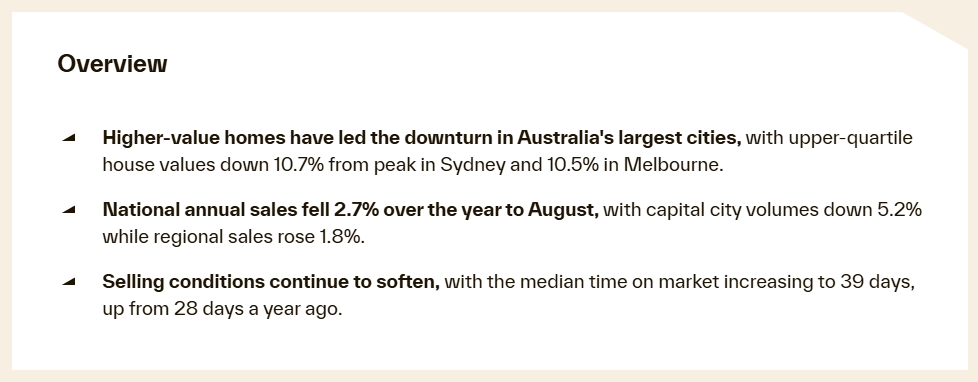
Melbourne has been one of the weaker capital city markets over the past quarter. Cotality’s latest data shows Melbourne values continued to decline through winter, with Melbourne among the capital cities experiencing a broad-based softening in values. Cotality reported that 93% of capital city suburbs recorded a decline through winter, highlighting how widespread the current market adjustment has become. (Cotality)
The divergence between houses and units is also important. The latest REIV data for Q2 2026 recorded a median Melbourne house price of $952,500, down 3.1% over the quarter, while the median unit price was $643,500, down 2.1%. (REIV) This highlights the relative affordability of Melbourne’s apartment market compared with houses, although both segments have experienced softer conditions.
Affordability is a major factor behind the change in buyer behaviour. Higher borrowing costs have reduced purchasing power, encouraging buyers to move further down the price spectrum and giving more affordable properties a relative advantage. There is also a substantial amount of property available to buyers, giving purchasers greater choice and negotiating power.
On the ground, it’s a challenging environment for selling agents, with vendor expectations still struggling to align with the lighter appetite from buyers.
Auction numbers are usually lower through winter, however we would normally expect activity to increase towards the end of August and into early spring. This year, the increase has been well below usual levels, while clearance rates remain considerably lower than normal.
Cotality’s final clearance rate for the week ending 30 August was 49.5% across the combined capital cities, compared with 69.3% at the same time last year. Melbourne recorded a 53.7% clearance rate that week. (Cotality) The result is a market where buyers are taking their time and vendors are increasingly having to respond to market feedback.
What We’re Expecting in the Months Ahead
We continue to believe Melbourne is undervalued relative to many other Australian markets. However, we expect the market to remain subdued in the short term, with buyers continuing to take a cautious approach and vendors gradually adjusting their expectations.
The Victorian state election in late November will be an important event to watch. If there is a change in government, we believe this could improve confidence and breathe some life back into the property market. However, any meaningful improvement is unlikely to be immediate. We would expect the effects to become more apparent from early 2027 rather than before Christmas.
In the meantime, Melbourne’s relative affordability is becoming increasingly attractive to buyers who have been priced out of other markets. For buyers with a long-term outlook, the current conditions provide an opportunity to negotiate in a market where competition is considerably lower than it has been in recent years.
Looking to buy in Melbourne?
Our local team has extensive experience across the Melbourne property market. To learn more about the surrounding suburbs and how we can help, visit our Melbourne buyers agent page.
SUNSHINE COAST
Looking Back on the Sunshine Coast Market This Past Quarter
The Sunshine Coast market is continuing to shift, with one of the most noticeable changes being the significantly lower attendance we’re seeing at open homes. Compared with earlier in the year, buyers are taking a much more measured approach, with fewer people attending inspections and less competition on the ground.
Auctions are producing mixed results. While there are certainly examples of properties selling under the hammer and achieving solid outcomes, they’re becoming more the exception than the rule. In many cases, properties are either being passed in or negotiations are continuing after the auction campaign, reflecting a more cautious buyer pool.
We’re also seeing a growing number of offers submitted subject to the sale of another property. This is a clear sign that many buyers are unwilling to take on additional risk and are prioritising certainty before making their next move.
At the same time, there’s very little sense of urgency in the market. Buyers know they have options, stock levels remain reasonable and many are happy to wait rather than rush into a decision.
Overall, the market feels balanced but slower. Buyers are still active, but they’re more selective, more condition-driven and less inclined to compete aggressively unless a property is truly exceptional. The fundamentals that have driven the Sunshine Coast’s growth for years are still firmly in place:
- Strong population growth and interstate migration
- Limited supply in many established coastal suburbs
- Major infrastructure investment
- The Maroochydore city centre and the jobs it will bring
- The 2032 Olympic and Paralympic Games
- Strong lifestyle appeal
- A tight rental market
- Relative affordability compared with many southern capital cities
Recent InfoTrack data also shows that Queensland’s overall property market is recalibrating after a period of strong growth, with sales activity becoming increasingly concentrated in particular locations and price points. Queensland house sales fell 38.9% in Q2 2026 compared with the previous quarter, while unit sales fell 37.8%. (InfoTrack)
The Sunshine Coast continues to benefit from strong lifestyle demand, however the broader Queensland figures reinforce the shift towards a more selective market.
What We’re Expecting in the Months Ahead
We expect the Sunshine Coast market to remain relatively measured over the coming months. There may be a slight increase in stock as we move further into the spring selling season, giving buyers more choice and reducing the need to compete quickly.
This is likely to place greater importance on realistic pricing for sellers. Properties that are priced well and offer the location, condition and features buyers are looking for should continue to perform, while properties that are overpriced may take considerably longer to sell.
The long-term outlook remains positive. Major infrastructure projects and investment ahead of the 2032 Olympic and Paralympic Games continue to support the region’s long-term appeal. For buyers, the current conditions provide an opportunity to slow down, undertake proper due diligence and negotiate rather than feeling pressured to make an immediate decision.
Looking to buy on the Sunshine Coast?
Our local team has extensive experience across the Sunshine Coast property market. To learn more about the surrounding suburbs and how we can help, visit our Sunshine Coast buyers agent page.
GOLD COAST
Looking Back on the Gold Coast Market This Past Quarter
After an extended period of robust growth, the Gold Coast property market has entered a more measured and balanced phase. Momentum has eased across a number of suburbs, with growth rates softening for the second consecutive quarter. This has been particularly noticeable within the apartment sector, which continues to bear the brunt of the market’s recalibration.
For houses, the majority of suburbs recorded a modest pullback in value this quarter, with declines generally ranging between 0% and 3%. The softening was more pronounced across the northern corridor than in the south, although overall movements remained relatively modest. Helensvale was one of the more significant movers, recording a 2.8% decline, while Miami was the strongest performer for houses, increasing by 1.8%.
The apartment market has continued to show more pronounced signs of softening. Molendinar and Broadbeach Waters recorded declines of 5.2% and 4.6% respectively. There are still pockets of strength, however, with Hollywell increasing by 4.3% and Banora Point recording a 3.2% increase for apartments and townhouses.
The change in conditions is also evident on the ground. Buyer numbers through open homes have reduced, with some properties attracting only two or three groups while others are still seeing eight to ten. Buyers are also taking longer to respond and are less inclined to take immediate action.
Agents are continuing to report an increase in contracts subject to the sale of another property, while finance clauses are becoming more prominent. Days on market have also increased, reflecting the broader shift towards a market where buyers have more choice and negotiating power.
Recent InfoTrack data supports the broader shift in buyer behaviour across Queensland. While overall unit sales fell 37.8% in Q2 2026, the Gold Coast continued to dominate Queensland’s unit market, accounting for six of the state’s top ten suburbs for unit sales. (InfoTrack)
What We’re Expecting in the Months Ahead
We expect little to no broad-based price growth between now and Christmas across the majority of Gold Coast suburbs. We may see a slight increase in stock as we move through the spring selling season, which should provide buyers with more choice. Auction clearance rates are likely to remain relatively low, with more properties being passed in and negotiations continuing after auction.
The growing use of subject-to-sale contract conditions is likely to continue as buyers become more cautious about taking on additional debt and sellers become more willing to negotiate.
The rental market should remain an important support for the Gold Coast. As more properties are purchased by owner-occupiers rather than investors, available rental stock is likely to remain tight, putting gradual upward pressure on rents.
Longer term, the Gold Coast remains supported by strong population growth, lifestyle appeal and a diversifying economy. The market is likely to become increasingly segmented, with well-located and tightly held suburbs continuing to perform better than areas with higher investor exposure or greater apartment supply.
Looking to buy on the Gold Coast?
Our local team has extensive experience across the Gold Coast property market. To learn more about the surrounding suburbs and how we can help, visit our Gold Coast buyers agent page.
NEWCASTLE
Looking Back on the Newcastle Market This Past Quarter
Newcastle and Lake Macquarie have now experienced four consecutive months of declining home values, marking a clear change from the stronger conditions seen earlier in the year.
According to the latest Cotality data provided in the Newcastle market update, the region’s median dwelling value fell 0.8% in August, taking the quarterly decline to 2.8%. The median dwelling value sits at approximately $1.02 million, while unit values have been somewhat more resilient, falling 0.6% to around $809,000.
The shift reflects the broader pullback in buyer demand, with Newcastle and Lake Macquarie now experiencing some of the same demand-side pressure that has emerged across other Australian markets. We’re seeing this reflected on the ground, with homes taking longer to sell and buyers having more choice than they did earlier in the year.
The median time on market across Newcastle and Lake Macquarie increased to 37 days over the three months to August, compared with 21 days in April.
For buyers, this represents a significant change in negotiating power. There is less pressure to make an immediate decision and more opportunity to assess comparable sales, negotiate on price and consider properties that may previously have attracted strong competition.
What We’re Expecting in the Months Ahead
We expect Newcastle and Lake Macquarie to remain in a period of adjustment over the coming months. As buyer demand continues to soften, vendors will need to become increasingly realistic about pricing if they want to secure a sale. We expect days on market to remain elevated and stock levels to continue building as some properties take longer to sell.
However, Newcastle’s long-term fundamentals remain attractive. The region continues to offer a combination of relative affordability, lifestyle appeal, employment opportunities and improving connectivity that should support demand over the longer term.
The current market is therefore less about a broad-based decline and more about a reset in expectations. For buyers, the coming months could provide opportunities to secure quality property with less competition and greater negotiating power than we’ve seen in recent years.
Looking to buy in Newcastle?
Our local team has extensive experience across the Newcastle property market. To learn more about the surrounding suburbs and how we can help, visit our Newcastle buyers agent page.
For recent stats, facts and figures on Australia’s residential property market, click here for Cotality’s (Core Logic) Monthly Housing Chart Pack.
PROPERTY CLOCKS
PMC analysis 14 markets (all Capital Cities and 6 major regional markets) utilising the data provided by key data houses such as Cotality, ABS etc and combines this data with what we are seeing on the ground in the markets that we have direct exposure to. Each market is then positioned at a different stage on the property clock, depending on where we believe it is situated in its current growth cycle. The 3 macro stages of the property clock are Value, Peak and Stagnation.
If you would like to understand where we believe these 14 markets are currently situated in their growth cycle, please click on the link below.
KEEP UPDATED
If you are on social media, please follow us to stay up to date on our latest purchases and regular on the ground market updates.