
2026 Winter Market Update
2026 Winter
Market Update
2 July 2026
“This feels like a boxing round in the ring with Muhammad Ali”
While residential property has proven remarkably resilient through major challenges over the past four decades, including the Global Financial Crisis, APRA lending restrictions and COVID-19, the market is currently navigating a rare combination of economic and political headwinds all at once.
Over the past five months, sentiment has been challenged by escalating conflict in the Middle East, which has contributed to higher oil prices and renewed inflationary pressures, three successive interest rate rises, growing uncertainty around the impact of artificial intelligence on employment, and perhaps most significantly, the Federal Government’s broad tax reforms. Individually, each of these factors would influence market confidence. Combined, they have created a level of uncertainty that is causing many buyers and sellers to pause.
Despite these challenges, residential property remains underpinned by a fundamental strength: housing is an essential human need. People will always prioritise having a roof over their head, which helps reduce the volatility and liquidity risks often seen in other asset classes. While the market is undoubtedly under pressure, history shows that housing has consistently demonstrated an ability to withstand periods of adversity.
National Market Update
Across the country, the market is showing clear signs of slowing, although conditions vary significantly between cities and price points. Sydney’s downturn is gathering pace and is expected to overtake Melbourne in terms of the speed of its correction in the coming months. At the same time, lower-priced properties across most markets are proving more resilient, supported in part by first-home buyer incentives and stronger affordability-driven demand. The largest price adjustments are generally occurring in higher-value segments.
Listing volumes are gradually increasing as properties take longer to sell and days on market continue to rise. Demand-side constraints were already evident before the Federal Budget, with housing affordability stretched to record levels. The national dwelling value-to-income ratio now sits at approximately 8.4, while mortgage repayments on a new loan consume nearly 46% of household income. Population growth is also returning to more normal levels after the strong post-COVID migration surge.
At the same time, real wage growth has softened while borrowing costs have increased, reducing purchasing power for many households. Consumer confidence remains well below long-term averages, and historically there has been a strong relationship between consumer sentiment and housing activity.
While the flow of new listings has eased in recent weeks, slower sales activity has allowed total listings to gradually build towards five-year average levels. Brisbane and Perth have seen particularly rapid increases in total listings, albeit from very low starting points.
Investor activity has remained elevated, accounting for around 41% of mortgage demand by volume during the first quarter of the year. However, we expect this figure to decline materially following the Federal Budget announcements. Meanwhile, rental markets remain exceptionally tight. National vacancy rates are holding near record lows at approximately 1.5%, and annual rental growth has accelerated to around 5.9%. Given the ongoing supply constraints and recent policy changes, we expect rental pressure to remain elevated over the coming months, which is unlikely to be welcome news for tenants.
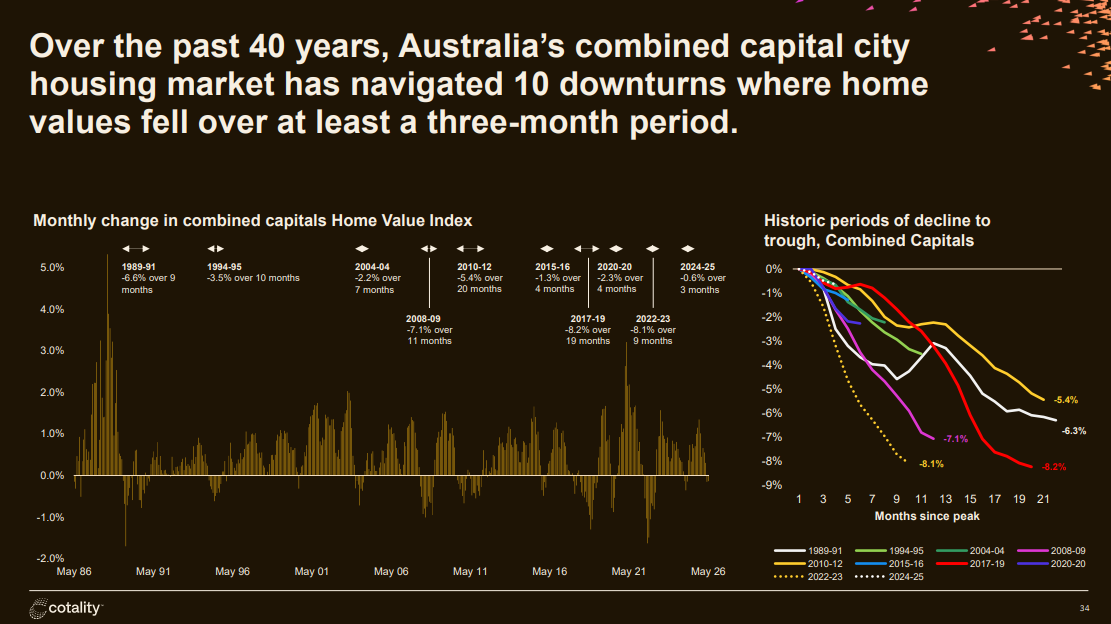
Importantly, history provides some perspective. Housing downturns in Australia have rarely lasted longer than 12 months, and over the past 40 years, combined capital city values have never fallen more than 8.2% from peak to trough. While today’s market faces significant challenges, the long-term track record of Australian housing suggests periods of correction are typically temporary rather than permanent and the corrections shallow, not deep.
What This Means for Buyers
For buyers, current conditions are creating opportunities. Stock levels are likely to remain relatively tight throughout winter, particularly for high-quality properties, as many sellers continue to delay listing decisions. However, reduced competition and softer sentiment are providing greater negotiating leverage than buyers have enjoyed in recent years.
We believe the next three months will present some excellent buying opportunities for well-prepared purchasers who are patient, financially secure and focused on long-term outcomes rather than short-term gains. While the market may continue to soften in the near term, sentiment is likely to improve once inflation begins to ease, interest rates approach their peak and economists start forecasting the beginning of a rate-easing cycle. When that shift occurs, competition is likely to return quickly.
SYDNEY
Note; our commentary is specifically focused on the Northern Beaches and North Shore marketplaces that we specialise in.
Looking Back on the Sydney’s Northern Beaches and Lower North Shore Markets in the Past Quarter
Over the past 12 months, we believe values across the Northern Beaches and Lower North Shore have generally softened by between 10% and 15%. However, this correction has not been evenly distributed. A-grade properties in tightly held locations have remained remarkably resilient, with some experiencing little to no decline, while C and D-grade properties have seen more significant price adjustments. Interestingly, the upper end of the market has borne the brunt of the downturn, whereas more affordable price points have continued to attract stronger buyer demand.
Agents are reporting that many sales campaigns are ultimately engaging with only one or maybe two genuine buyers. As a result, vendor price expectations are increasingly being challenged, leading to longer days on market and higher levels of discounting before a sale is achieved. These conditions have also discouraged many prospective sellers from listing, contributing to a further reduction in available stock.
Predicting the Sydney Market Moving Forward
We expect market activity across Sydney to remain subdued through winter, particularly during the school holiday period when buyer and seller engagement typically slows further. While transaction volumes may remain low, the current environment continues to present favourable opportunities for well-prepared buyers who are willing to be patient and selective.
We remain active on behalf of a number of clients who recognise the advantages of today’s buying conditions. With less competition and greater negotiating power available, success is often determined by patience, discipline and access to opportunities beyond the major property portals. Our focus remains on leveraging deep sourcing strategies to uncover quality properties, including those that are not currently being marketed publicly.
BRISBANE
Note; the comments below are for the inner-city suburbs of Brisbane and the Redcliffe peninsular
Looking Back on the Brisbane Market This Past Quarter
Brisbane started the quarter strongly, with March delivering solid buyer activity and continued price growth. However, sentiment shifted noticeably following the Easter school holidays and in the lead-up to the Federal Budget announcement in early May, as uncertainty surrounding government policy, interest rates and global events began to influence buyer behaviour. Since May, we have observed a moderate market adjustment across most price points, with inner-city properties under $1.3 million pulling back by around 5-7%, homes between $2 million and $3 million softening by approximately 5%, and prestige properties above $3 million experiencing corrections of between 5-10%. The standout performer has been the $1.3 million to $2 million house market, which has remained the most resilient segment.
While buyer numbers have reduced, listing volumes have also fallen as many sellers choose to delay their plans amid weaker market sentiment, helping maintain a degree of balance between supply and demand. Our team has observed open home attendance falling by around 30-40% compared to pre-budget levels, although owner-occupiers remain active, albeit in smaller numbers. This shift has created some excellent opportunities, particularly for buyers upgrading their homes, as larger price adjustments have generally occurred at the upper end of the market. For now, however, many buyers remain on the sidelines, adopting a cautious wait-and-see approach while closely monitoring economic conditions and the outcome of the conflict in the Middle East.
What We’re Expecting in the Months Ahead
With uncertainty surrounding interest rates, global geopolitical tensions and the recent Federal Budget still influencing sentiment, we expect buyer confidence to remain subdued over the coming months as many purchasers continue to adopt a wait-and-see approach. Media coverage is likely to amplify this uncertainty, further contributing to cautious decision-making. However, for buyers prepared to act, current conditions are creating strong negotiating opportunities, particularly for those who have a clear understanding of value in an adjusting market. Encouragingly, the RBA’s decision to leave interest rates unchanged has removed one potential headwind, and as the practical implications of the Budget become clearer, we expect confidence to gradually improve. Our view is that the price adjustments seen over the past two months are beginning to stabilise, and once buyers recognise that a significant market correction is unlikely, the current lull may give way to increased activity. Looking ahead to spring, there is potential for a resurgence in buyer demand and competition – subject to future interest rate movements by the RBA.
MELBOURNE
Looking Back on the Melbourne Market This Past Quarter
Melbourne’s property market lost momentum over the June quarter, although conditions varied significantly across different property types. According to Cotality data, house values declined 0.8% in April and fell 2.1% across the quarter. Despite the recent softening, annual growth remains positive at 2.5%, with Melbourne’s median house value now sitting at approximately $972,734.
Buyer confidence has moderated considerably compared to the strong conditions seen late last year. A combination of three consecutive RBA rate rises, uncertainty surrounding the Federal Budget and broader geopolitical concerns have caused many buyers, particularly investors, to become more cautious in their decision-making. While enquiry levels remain healthy for high-quality properties, buyers are taking longer to commit and are being far more selective than they were six months ago.
One of the defining themes of the quarter was the growing divergence between houses and apartments. While detached homes experienced declining values, Melbourne’s unit market continued to demonstrate resilience. RPM Group data shows unit values reached a three-year high of $656,500 at the end of 2025, recording quarterly growth of 2.0% and outperforming the house market over the same period.
Middle-ring and outer-ring apartment markets were particularly strong. Unit values in Melbourne’s middle-ring suburbs climbed to approximately $757,500, the highest level in four years, while outer-ring unit values reached a record $650,000. Quarterly growth of 2.9% and 2.5% respectively highlights the continued demand for more affordable housing options across the city.
Affordability remains a major driver of demand, particularly as rising house prices continue to push many owner-occupiers towards apartments. Investors have also increasingly shifted their focus to the unit market, attracted by stronger rental returns and lower entry price points. This trend has helped support the apartment sector despite broader market uncertainty.
We also saw the impact of strong lending activity from late 2025 continue to flow through the market. According to RPM Group’s analysis of ABS lending data, Victoria recorded more than 43,000 new housing loans during the December quarter of 2025, the highest quarterly volume since mid-2022. This lending surge created strong momentum heading into 2026, however confidence has eased in recent months, with many buyers adopting a more measured approach following the Federal Budget and ongoing economic uncertainty.
Overall, Melbourne now sits approximately 1.9% below its cyclical peak reached in November 2025, according to Cotality data, having unwound a meaningful portion of the gains achieved during the latter stages of 2025 and early 2026. While conditions have softened, well-located and affordable properties, particularly apartments in middle-ring and outer-ring suburbs, continue to attract strong interest from both investors and owner-occupiers.
What We’re Expecting in the Months Ahead
Melbourne is likely entering a period of softer, more subdued trading rather than a dramatic correction. While we may see further modest softening in some segments, current indicators point towards a slower-moving market rather than a significant downturn.
Apartments are expected to remain the strongest-performing sector in the near term. Government policy support, affordability advantages and stronger rental returns continue to drive demand from both owner-occupiers and investors. RPM Group data shows Melbourne’s unit market has already begun outperforming houses, with unit values reaching a three-year high of $656,500 at the end of 2025 and continuing to outperform detached housing across key growth metrics. As affordability pressures persist and construction costs remain elevated, apartments are likely to play an increasingly important role in Melbourne’s housing market.
One of the strongest factors supporting Melbourne’s long-term outlook is the ongoing supply shortage. ABS data shows dwelling completions across Victoria fell by 25.5% in the June 2025 quarter compared to the same period a year earlier. At the same time, REA Group reported a 10.4% decline in property listings between October 2024 and October 2025. This combination of reduced new housing supply and lower listing volumes continues to create a supply-demand imbalance that is expected to support property values over the medium to long term.
For owner-occupiers, current market conditions are creating opportunities that were difficult to access during the more competitive conditions of 2024 and early 2025. With buyer competition easing, many purchasers are finding themselves in stronger negotiating positions, particularly when upgrading to larger family homes. Vendors are generally becoming more realistic on pricing and more flexible during negotiations, creating favourable conditions for well-prepared buyers.
For investors, the recovery story has shifted slightly. While many anticipated 2026 would mark the beginning of Melbourne’s next major growth cycle, that timeline now appears more likely to extend into 2027 or beyond. However, for investors with a long-term outlook of seven to ten years, the current market presents a compelling opportunity. With Melbourne positioned post-trough, interest rate cuts likely once inflation is under control and population growth continuing to accelerate, strategic investors are increasingly looking to secure quality assets ahead of expected growth conditions in the medium term.
The June 2026 quarter has ultimately been a tale of two markets. Houses have softened under the weight of interest rate pressures, economic uncertainty and cautious buyer sentiment, while apartments have continued to benefit from affordability advantages, stronger rental returns and supportive government policies. Despite the short-term challenges, Melbourne’s long-term fundamentals remain firmly in place, supported by strong population growth, constrained housing supply and improving affordability relative to other major capital cities.
SUNSHINE COAST
Looking Back on the Sunshine Coast Market This Past Quarter
The Sunshine Coast has carried strong momentum into 2026, although growth has moderated from the rapid pace seen in recent years. According to REIQ data for the December 2025 quarter, median house prices rose 5.9% over the quarter and 11.4% over the year to approximately $1.17 million, while unit values increased 5.9% quarterly and 11.1% annually to around $800,000.
Despite this easing in pace, the underlying fundamentals remain unchanged. Population growth, lifestyle migration, constrained land supply and an exceptionally tight rental market continue to support demand. National rental vacancy rates remain near record lows at around 1.5% (Cotality Monthly Housing Chart Pack, March 2026), which is sustaining rental growth and supporting investor interest across the region.
A key long-term driver is population expansion. CBRE and ABS projections indicate the Sunshine Coast will gain nearly 56,000 residents by 2032, requiring around 23,000 new dwellings (more than 3,000 per year), alongside significant additional demand for industrial, office and retail space. This highlights the scale of infrastructure and housing needed to keep pace with growth.
Supply remains structurally constrained. National listings are approximately 14% lower year-on-year and 17.8% below the five-year average, reinforcing ongoing price support even as market momentum slows.
Buyer behaviour has also shifted. The market is becoming more selective and value-driven, with strong demand focused on well-located family homes near schools, transport and town centres. Lower-quality or poorly positioned stock is taking longer to sell and facing more price sensitivity.
Overall, while growth is moderating, the Sunshine Coast remains underpinned by strong structural demand drivers, tight supply conditions and resilient rental markets. Long-term performance is increasingly being shaped by quality, location and affordability dynamics rather than broad-based market momentum.
What We’re Expecting in the Months Ahead
We expect the Sunshine Coast property market to continue recording price growth through 2026, although without the intensity or urgency seen during the post-pandemic boom. Growth is expected to be steadier and more selective, with performance increasingly driven by quality, location and long-term liveability rather than broad-based momentum. SQM Research forecasts Sunshine Coast property prices to rise by around 10–15%, compared to a national capital city average of 6–10%, highlighting the region’s continued relative outperformance.
A key structural driver remains population growth. CBRE and ABS projections indicate the Sunshine Coast will add nearly 56,000 residents by 2032, requiring approximately 23,000 new dwellings, or more than 3,000 per year. This ongoing population expansion continues to underpin long-term housing demand, while also increasing pressure across infrastructure, commercial space and essential services.
Supply constraints remain one of the most important supporting factors for the market. New data from Cotality shows that 90 out of 95 Sunshine Coast suburbs now have median house prices above $1 million, compared with fewer than 20 suburbs just five years ago. This shift reflects both sustained demand and limited new housing supply, reinforcing higher price floors across much of the region.
At the same time, affordability pressures are becoming more visible. Buyers are increasingly selective, particularly in higher price brackets, and are placing greater emphasis on value, land content, and long-term liveability. This is contributing to a more segmented market, where not all properties are experiencing equal demand.
Looking ahead, supply is expected to remain constrained, which should continue to support both values and rental conditions. However, the nature of demand is shifting. For both investors and owner-occupiers, strategy is becoming more important than market momentum. Properties with strong land content, good access to amenities and broad appeal are expected to outperform as the market transitions into a more sustainable phase of growth.
Overall, while the Sunshine Coast is expected to continue growing in 2026, the opportunity increasingly lies in selectivity and positioning rather than broad market uplift.
GOLD COAST
Looking Back on the Gold Coast Market This Past Quarter
The Gold Coast property market entered the second quarter with a clear shift in sentiment, with buyer activity softening as households responded to the Federal Budget, consecutive interest rate rises and a more uncertain macroeconomic backdrop. While underlying demand remains supported by strong population growth, limited supply and the region’s lifestyle appeal, conditions have become more price-sensitive, with affordability pressures and policy uncertainty weighing more heavily on buyer confidence.
Despite this, house prices continued to edge higher across most suburbs. Every suburb recorded positive growth over the quarter, although gains were generally modest at under 1%. The strongest performing house markets were lifestyle and family-oriented suburbs, including Tweed Heads South, Tugun, Miami and Mermaid Beach, which recorded quarterly growth in the 3% to 6% range. Hinterland suburbs such as Tallai, Mudgeeraba, Bonogin, Reedy Creek, Tallebudgera Valley and Currumbin Valley also outperformed, alongside northern suburbs including Nerang, Ashmore, Southport, Parkwood, Biggera Waters, Oxenford and Paradise Point. This reflects continued owner-occupier demand for space, lifestyle and family housing.
In contrast, the apartment market showed clearer signs of softening. There was a slight uplift in supply and more suburbs recorded minor quarterly declines, generally under 1%, including Coolangatta, Bilinga, Currumbin, Elanora and Broadbeach. Merrimac was the standout performer, recording 7.3% quarterly growth and the only suburb to exceed 6%. Most other apartment markets ranged between 0% and 3% growth, highlighting more uneven performance across coastal unit markets and softer investor demand in higher-density areas.
A notable behavioural shift has been the rise in “subject to sale” contract conditions. Agents report this has become increasingly common as buyers look to secure property while still needing to sell their existing home, adding another layer of negotiation complexity and slowing down transaction certainty.
Overall, affordability remains a key driver of demand, with the $800,000 to $1.2 million price segment continuing to perform most strongly. At the same time, days on market are gradually increasing, signalling a slower and more considered trading environment compared to earlier in the cycle.
What We’re Expecting in the Months Ahead
The Gold Coast property market is expected to become increasingly fragmented over the near term, with growth continuing but at a more restrained and selective pace rather than broad-based expansion. Current conditions already reflect this shift, with buyer activity softening, days on market gradually increasing and negotiation dynamics becoming more favourable for buyers compared with the stronger conditions seen in 2024 and early 2025. A notable behavioural change has been the rise of “subject to sale” contract conditions, which agents report are now a standard feature of negotiations rather than an exception.
Despite this moderation in sentiment, structural supply constraints continue to provide support for values. ABS data shows dwelling completions fell by 25.5% in the June 2025 quarter compared with the same period in 2024, while REA Group data recorded a 10.4% decline in listings between October 2024 and October 2025. This tightening of supply continues to underpin prices even as buyer demand becomes more cautious and selective.
Looking ahead, performance is expected to diverge further between segments of the market. Prime owner-occupier suburbs with strong lifestyle appeal and limited supply are likely to remain the most resilient, supported by ongoing population growth and consistent demand for family housing. In contrast, investor-heavy apartment markets are expected to face more pressure from affordability constraints and higher borrowing costs, particularly in higher-density coastal areas.
The $800,000 to $1.2 million price bracket is expected to remain the most active part of the market, sitting closest to the Gold Coast’s affordability sweet spot for both owner-occupiers and upgraders. Higher-priced discretionary segments are likely to experience more patchy demand, with performance increasingly dependent on location, quality and perceived long-term value. At the same time, rental conditions remain extremely tight across the region, supporting yields and sustaining investor interest despite broader caution.
A growing structural challenge is emerging in the development sector, with rising construction costs widening the gap between the cost of delivering new apartment stock and what buyers are willing to pay. This is pushing new projects toward higher price points and limiting the supply of more affordable housing, particularly in coastal and high-demand precincts.
Overall, the Gold Coast is transitioning into a more strategic phase of the cycle. Quality assets in tightly held locations are expected to continue performing well, but broad-based rapid growth is unlikely to return in the immediate term. Any market weakness is more likely to be driven by softer buyer demand rather than forced selling, with most homeowners still holding strong equity positions. The key risk remains concentrated among more recent buyers who may have taken on higher leverage during peak conditions.
NEWCASTLE
Looking Back on the Newcastle Market This Past Quarter
Newcastle and Lake Macquarie continued to record positive growth over the quarter, although momentum clearly cooled as autumn transitioned into winter. According to Cotality’s Home Value Index (HVI), dwelling values across the combined region rose 0.2% in May, taking the median dwelling value to approximately $1,050,347. While still positive, this marked a clear slowdown from the 0.9% monthly growth recorded in April, signalling a moderation in momentum across the market.
Over the broader quarter, dwelling values increased by 2.0% to May and are now 10.6% higher over the past 12 months. Despite this annual growth remaining strong, the monthly trend highlights a cooling phase, with buyer activity becoming more selective and price sensitivity increasing compared with earlier in the year. Even so, the region continues to outperform many major capital city markets, reflecting ongoing demand fundamentals across the Hunter region.
On the ground, this shift in conditions is becoming more visible. Open home attendance has eased, price discounting is more common and days on market have extended compared with early 2026 conditions. Agents are also increasingly presenting off-market opportunities, often a sign that vendors are becoming more flexible and realistic in response to changing buyer depth.
Performance across the region has also become more fragmented. Newcastle was the weakest-performing sub-market in the latest Cotality data, with dwelling values falling 0.4% in May to a median of $1,053,234. In contrast, Lake Macquarie provided much of the relative strength that supported overall regional growth. As Cotality head of research Gerard Burg noted, “the broader Newcastle and Lake Macquarie region was held up by a little bit stronger performance around Lake Macquarie, rather than Newcastle itself.”
Across the quarter, the strongest-performing segments have generally been boutique townhouses and villas in premium coastal suburbs, particularly those with strong owner-occupier appeal. These properties continue to attract interest due to lifestyle demand and relative scarcity, even as broader market momentum softens.
What We’re Expecting in the Months Ahead
We expect the Newcastle and Lake Macquarie market to remain fundamentally stable, but more balanced than the stronger seller conditions seen over the past few years. Current on-the-ground indicators already reflect this transition, with fewer attendees at open homes, increased price discounting and longer days on market compared with earlier in the cycle. Agents are also reporting a rise in quality off-market opportunities being presented to buyers, suggesting vendors are becoming more flexible on both price and terms as conditions normalise.
Despite this softening in momentum, demand remains strongest for well-located, high-quality stock, particularly in coastal lifestyle suburbs where supply remains tightly held.
Property type performance is also diverging. Boutique townhouses, villas and low-maintenance homes continue to outperform, particularly in established coastal suburbs with strong owner-occupier appeal. These properties are consistently attracting higher enquiry levels, shorter time on market and stronger price resilience compared with larger or less turnkey housing stock, where buyer demand has become more price-sensitive.
The increase in off-market activity is a trend we expect to continue, as agents and vendors increasingly test buyer demand before launching to broader competition. This is creating opportunities for well-connected buyers to secure quality assets earlier in the campaign, often with improved negotiating positions.
Overall, the market is shifting from a fast-moving seller’s environment into a more considered and balanced phase where pricing accuracy, presentation and negotiation strategy are becoming far more important than they were 12 months ago.
For recent stats, facts and figures on Australia’s residential property market, click here for Cotality’s (Core Logic) Monthly Housing Chart Pack.
KEEP UPDATED
If you are on social media, please follow us to stay up to date on our latest purchases and regular on the ground market updates.