
2026 Autumn Market Update
2026 Autumn
Market Update
Navigating uncertainty
Uncertainty = opportunity (if you are clear on your “why”)
There’s no shortage of global and local uncertainty at the moment and it’s fair to say both the media and social algorithms are amplifying it.
The reality is, no one can predict with certainty what the near-term outlook holds, or how current geopolitical tensions will play out over the longer term. Markets don’t operate in straight lines, and periods like this naturally create hesitation.
For some buyers, this environment is prompting a reassessment.
For those who are more sensitive to interest rates, the current inflationary backdrop is a timely reminder to review borrowing capacity, cash flow, and the strength of financial buffers. These factors matter more now than they have in recent years.
For others who are less directly impacted by rate movements, there can be great opportunities. Uncertainty can reduce competition and increase the motivation of vendors and agents.
What we are seeing in the current market is a divergence in behaviour. Some buyers are choosing to wait for greater clarity, while others, typically those with well-defined goals, appropriate financial buffers and a clear understanding of their risk position, are continuing to act, albeit patiently and selectively.
There is no single “right” approach in the current environment, only what is appropriate based on individual circumstances, risk tolerance, and long-term goals. If history is anything to go by, uncertainty often leads to lower stock levels, as vendors take a wait and see approach. If this transpires again, it will underpin the market, and buyers and vendors will return once they have more certainty.
As always, the focus for buyers should be about making informed, balanced decisions aligned to long term buying goals.
National Market Update
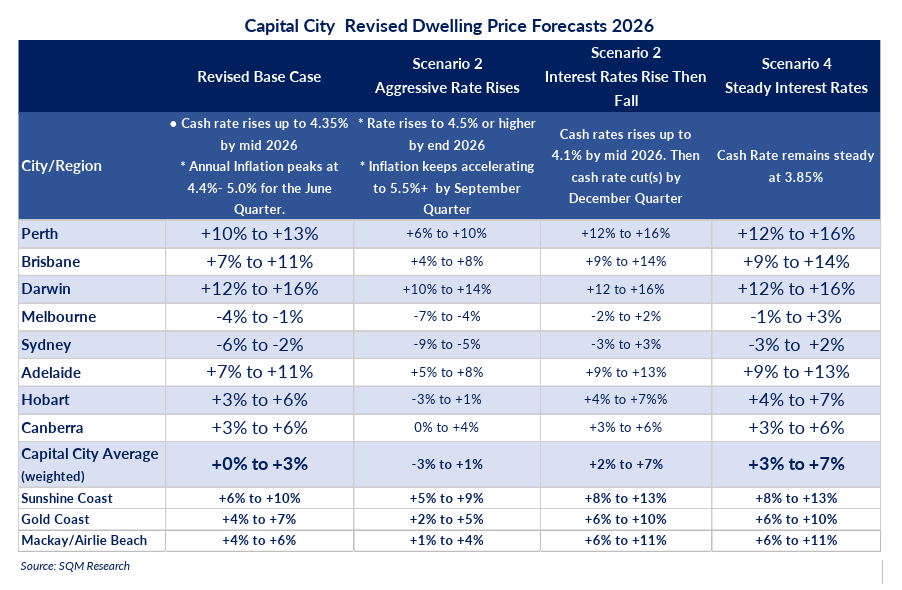
Property market sentiment is incredibly powerful, and in the digital age it can change almost overnight. The broader Australian market started 2026 on a positive note, but recent events such as the conflict in the Middle East and two consecutive interest rate rises could quickly slow the momentum. Over the past quarter, Australian housing values increased by 2.1%, with a 12-month rise of 9.9%. Looking closer at capital cities, dwelling values in the lower quartile rose 11.5% over the past year, compared with 6.6% in the upper quartile according to CoreLogic. Rental vacancy rates remain tight, sitting at 1.5% in February, close to record lows. This has pushed rents up 5.5% over the 12 months leading to February. Gross yields are averaging 3.6%, with significant differences across capital cities and regional markets.
SYDNEY
Note; our commentary is specifically focused on the Northern Beaches and North Shore marketplaces that we specialise in.
Looking Back on the Sydney’s Northern Beaches and Lower North Shore Markets in the Past Quarter
Buyer enquiry was very strong in the first two months of the year, particularly after the school holidays wrapped up. Many buyers were clearly motivated to enter the market, even with the backdrop of expected future rate rises, which made for an interesting dynamic to observe. In February, we achieved some excellent outcomes for our clients, and looking back, it’s worth considering whether these results were influenced by nervous vendors keeping one eye on the anticipated rate increases and their potential impact on the market.
Predicting the Sydney Market Moving Forward
Over the past couple of weeks, we’ve noticed a real shift in vendor, agent, and buyer behaviour. Agents report that buyers are holding back, with most properties attracting only one genuinely qualified or engaged buyer. Vendors committed to selling are feeling anxious about the unknown ahead, making them more open to early offers and willing to negotiate. This week alone, we secured two properties where agents came back with revised price expectations, and we expect this trend to continue. Current conditions are creating excellent buying opportunities, which means we are carefully refining our negotiation strategies as a team to secure the best prices and outcomes for our clients. The sub-$1.5 million unit market remains resilient, supported by first-home buyer incentives, though rising interest rates may lead some buyers in this bracket to reduce budgets to manage cash flow. In contrast, the mid-tier housing market between $3 million and $5 million is likely to be patchier, as buyers in this range tend to be more sensitive to interest rate changes.
BRISBANE
Note; the comments below are for the inner-city suburbs of Brisbane and the Redcliffe peninsular
Looking Back on the Brisbane Market This Past Quarter
Brisbane started 2026 strongly, with momentum from late 2025 carrying into January and February. The sub-$1 million market remains extremely competitive, with buyer demand exceeding available supply. Housing within 15–20km of the CBD up to mid/high $1 million continues to experience strong competition. Properties above $2 million are taking slightly longer to sell, while prestige properties, including those above $10 million, are generally selling within expected price guides. Some high-growth suburbs that have seen 10–15% growth over the past 12 months are showing signs of buyer caution, possibly indicating affordability limits. Returning listings from Q3 and Q4 of 2025 have sold quickly, and first-home buyers are increasingly using parental guarantees to compete. On the Redcliffe Peninsula, house prices now exceed $1 million, sale times have lengthened slightly (typically within a week), and rental yields are tightening. Redcliffe also recorded its first-ever $10 million-plus house settlement in 2025, reflecting high demand for beachfront properties.
What We’re Expecting in the Months Ahead
Looking forward, the commencement of 2032 Olympics infrastructure will put pressure on construction trades, likely increasing construction costs. The sub-$1 million market may slow slightly as government incentive thresholds are reached, while upcoming low-medium density zoning expansions near train stations could create future development opportunities. Houses and townhouses priced between $1–1.7 million are expected to perform strongest. Rental yields may continue to compress until capital growth moderates and rents catch up. South East Queensland’s ongoing housing undersupply — approximately 40,000 fewer homes delivered annually than required — will continue to underpin demand across Brisbane, the Gold Coast, and Sunshine Coast, supporting stable long-term growth.
MELBOURNE
Looking Back on the Melbourne Market This Past Quarter
Melbourne experienced a slow, seasonal start to 2026, with activity gradually building from February. Buyer sentiment has remained cautious following the February interest rate rise, and market conditions have been patchy across suburbs and property types, creating selective opportunities for well-informed buyers. Older-style apartments in established areas have seen renewed demand, with stronger competition in these pockets. Open home attendance and general activity improved through February and early March, although many buyers remained cautious due to interest rates and global uncertainties.
What We’re Expecting in the Months Ahead
Looking ahead, some buyer caution is expected to persist amid ongoing interest rate uncertainty and global factors. Interstate investors are showing increasing interest in Melbourne due to its relative affordability, and the seasonal lift in stock through February and March is likely to create buying opportunities. April may see interruptions from Easter, school holidays, and ANZAC Day, leading to more off-market and private sales. Buyers with a long-term outlook are expected to benefit, while those focused on short-term gains may risk missing out.
SUNSHINE COAST
Looking Back on the Sunshine Coast Market This Past Quarter
The Sunshine Coast remains underpinned by strong fundamentals, including lifestyle appeal, population growth, and chronic undersupply, with around 3,470 new homes required annually. The region has consistently led the nation in capital-to-regional migration, outpacing the Gold Coast in nine of the last ten quarters. Vacancy rates are exceptionally low at about 1%, supporting rental yields. Family homes and well-located apartments have continued to attract strong demand, supported by infrastructure projects including those tied to the 2032 Olympics.
What We’re Expecting in the Months Ahead
The Sunshine Coast is evolving into a metro-regional hybrid, attracting families, professionals, and business owners. Ongoing supply constraints and low vacancy rates are expected to continue supporting prices, particularly for high-quality, well-located properties. Older or less well-located stock may see more subdued results. Long-term infrastructure, lifestyle appeal, and population growth are expected to underpin the market well beyond 2026. Rental conditions are likely to remain tight, sustaining investor confidence.
GOLD COAST
Looking Back on the Gold Coast Market This Past Quarter
The Gold Coast has seen strong underlying demand, though growth has slowed in some areas. On the southern Gold Coast, most house suburbs recorded growth under 3%, while Bonogin and Currumbin Valley saw slight decreases. Northern suburbs generally grew above 3%, with Highland Park, Coomera, Upper Coomera, Nerang, Pacific Pines, and Oxenford performing well. Unit price growth was strongest in Ashmore, Southport, and Varsity Lakes, while northern suburbs grew mostly 3–6%. Median unit values now exceed $1 million in many southern suburbs, while northern suburbs remain below $900k. Median weekly rents have risen to over $1,100 for houses and $700 for units, up 5–10% over the past year.
What We’re Expecting in the Months Ahead
The Gold Coast remains supported by lifestyle demand, low supply, and a diversifying economy, with construction, health, and education now leading the region’s economic activity. Unit price growth is expected to remain strong due to affordability pressures, while houses in desirable areas are likely to perform steadily. Despite moderation in quarterly growth, ongoing low stock and tight rental conditions will continue to underpin demand and provide a resilient market for both buyers and investors.
NEWCASTLE
Looking Back on the Newcastle Market This Past Quarter
Newcastle has continued to experience strong demand, particularly in the sub-$3 million segment, where competition has pushed prices higher. Recent infrastructure announcements, including $230 million in federal funding for the Sydney–Newcastle high-speed rail and proposed international route expansions at Newcastle Airport, have supported buyer interest. New Lambton has remained popular for its family-friendly, lifestyle-rich appeal, while outer-ring suburbs such as Cardiff, Glendale, and Wallsend have attracted first-home buyers and families seeking affordable space. Inner coastal and CBD suburbs, including Bar Beach, Cooks Hill, The Junction, and Merewether, continue to see low stock and strong demand for townhouses and units with outdoor space.
What We’re Expecting in the Months Ahead
Newcastle’s focus on sustainable development, public spaces, arts, and innovation is expected to continue enhancing liveability. Infrastructure investment and lifestyle appeal are likely to support migration and long-term demand, providing opportunities for both owner-occupiers and investors. The combination of affordability, lifestyle, and improved connectivity will continue to make Newcastle an attractive regional market.
For recent stats, facts and figures on Australia’s residential property market, click here for Cotality’s (Core Logic) Monthly Housing Chart Pack.
PROPERTY CLOCKS
In partnership with other research companies, PMC analyse the 32 largest population bases (capital cities and major regional markets) in the country to assess where each market is currently situated in its cycle.
Please click the link below to gain an understanding of where we believe the current markets are placed in their property cycle.
KEEP UPDATED
If you are on social media, please follow us to stay up to date on our latest purchases and regular on the ground market updates.